
Story
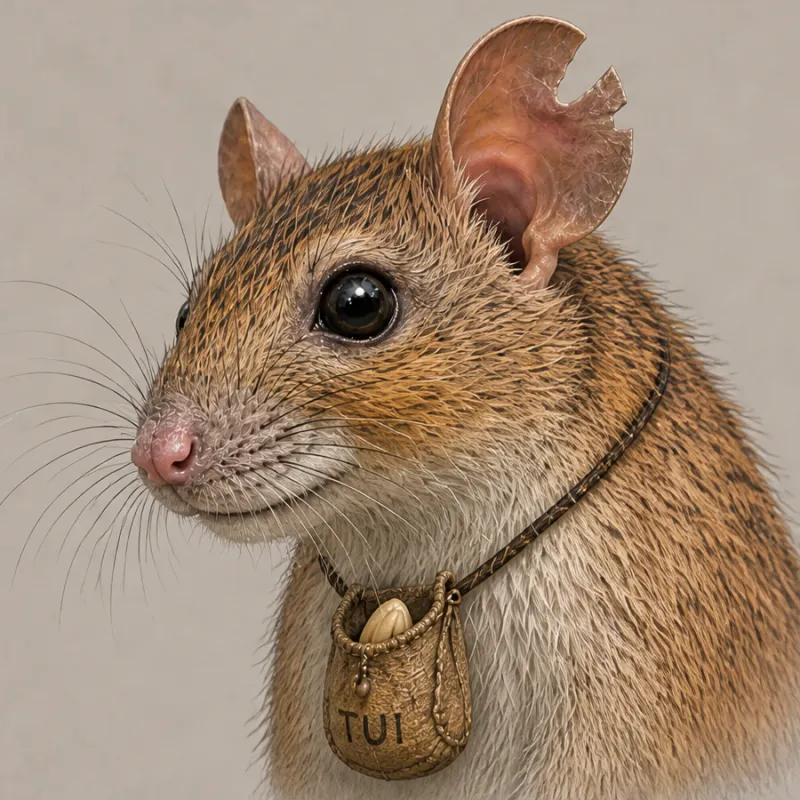
Tui was born Nu Na, fourth of six pups in a small burrow at the edge of a rice paddy in Isan. When the fields were burned after the harvest, the fire jumped the channel and took her mother, her family and her home. She was the only one who made it out, with a notch in her left ear.
Her father sent her south to Bangkok. Before she left he gave her one grain of rice from the last harvest. She keeps it in a cloth pouch around her neck: “ข้าวเม็ดนี้... ตัวแทนของพ่อ”, “this grain of rice… my father’s proxy.”
Now she lives under the soi. She works, and she sends money home. Top found her at the edge of a food cart and offered her a job, not pity. Ask her why she’s called Tui and she’ll tell you: “Because the fire took Nu Na. Tui is the one who walked here.”
Look
- Small and lean, more fragile-looking than she is
- Brindled orange-brown back and a pale belly: country colours, slowly turning city-grey
- A notched left ear, from the fire
- Dark, wide, watchful eyes that track the exits
- A tiny cloth pouch with one grain of rice
Traits and habits
- Quiet and watchful. She speaks slowly, in short sentences, because every word costs her.
- She doesn’t accept charity. She accepts work. Work has dignity.
- She loves her family, even the village she can’t afford to visit.
- Quick, precise, silent. She doesn’t walk into a room; she arrives.
- She trusts Top first, Angpao next, then Siri. Tuk last, because Tuk is the sky.
Friends
- Top: gave her a job, and a place at the desk.
- Angpao: the first to notice the new rat under the soi. He looks out for her without ever saying so.
- Siri: makes her laugh. Two outsiders who came to Bangkok for different reasons.
- Tuk: sees her from above.
Watch
EP04: The Last GrainThe real animal: the ricefield rat
The ricefield rat lives throughout Southeast Asia, Thailand included. It is a medium-sized rat, about 30–40 cm long, with a tail of 14–20 cm, and weighs roughly 97–219 grams. Its fur is a grizzled yellow-brown and black.1
It lives in groups led by a dominant male and is most active at night, dusk and dawn. You might spot one by day among weeds or a ripening field. After a three-week pregnancy, a female has 5 to 10 young.1
Its whole life runs on the rice calendar. A field study in the Philippines found that ricefield rats breed most when the rice is forming and ripening, and that litters are largest at the ripening stage.2 That is why farmers count it as a major pest of rice.1
It is listed as Least Concern: common across its range.1